Sublingual Absorption: How It Works
What is Sublingual Delivery?
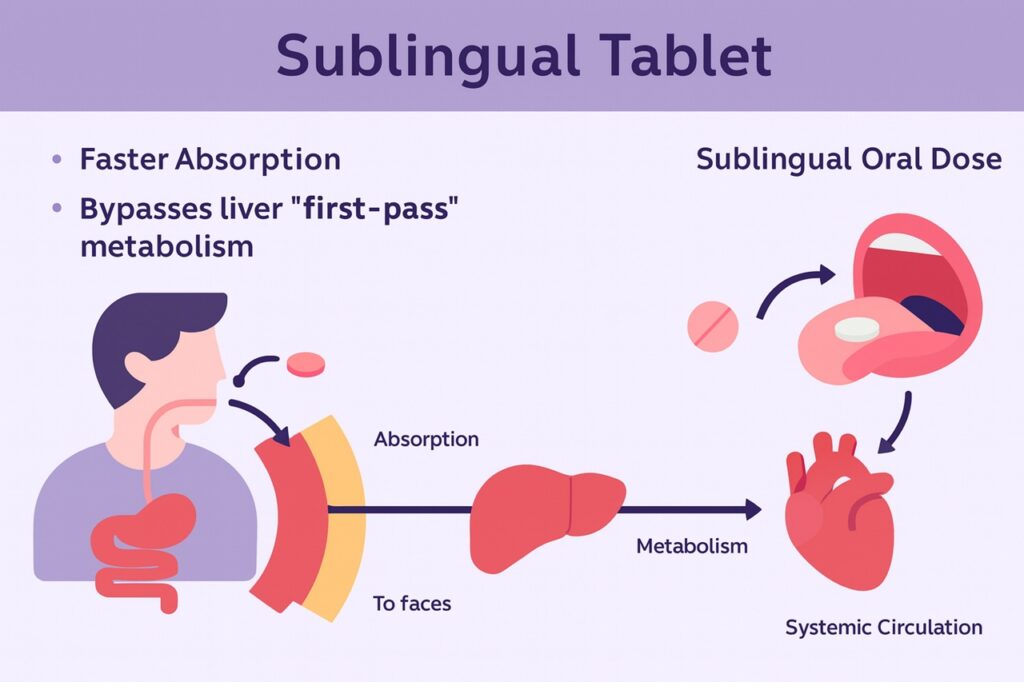
Sublingual administration involves placing a specially formulated tablet beneath the tongue, where it is allowed to dissolve in contact with the sublingual mucosa.
Rather than being swallowed immediately and passing through the gastrointestinal tract, the formulation is designed to enable absorption across the tissues beneath the tongue.
The sublingual region is highly vascularised, making it a potential route for systemic drug delivery. However, the extent and consistency of absorption depend on the active ingredient, formulation, dose, residence time and individual patient factors.
At Eat Less Method, sublingual treatment may be considered as part of an individually prescribed weight-maintenance strategy, following clinical assessment by a qualified prescriber.
Why the route of administration matters
The way a medicine is administered can influence its absorption, convenience, tolerability and suitability for long-term treatment.
Subcutaneous Injection
Injectable medicines are administered into the tissue beneath the skin.
Characteristics include:
- Delivered directly into subcutaneous tissue
- Predictable absorption
- Requires needles and cold storage
Injectable GLP-1 receptor agonists have an established role in the management of obesity and type 2 diabetes where clinically appropriate.
Swallowed oral Medicines
Conventional oral medicines pass through the stomach and gastrointestinal tract before absorption.
For peptide medicines, this can present particular challenges because peptides may be susceptible to degradation by gastric acid and digestive enzymes.
Depending on the medicine and formulation, oral delivery may therefore require specialised formulation technology, particular administration conditions or higher drug quantities to achieve clinically meaningful systemic exposure.
Sublingual Administration
With sublingual administration, the formulation is placed beneath the tongue and allowed to dissolve.
The aim is to maintain contact between the formulation and the oral mucosa and provide an opportunity for the active ingredient to be absorbed through the sublingual tissues.
Sublingual absorption is formulation-dependent and should not be assumed to produce the same systemic exposure as injectable administration.
Potential practical characteristics of sublingual administration include:
- Needle-free administration
- Avoidance of immediate passage through the stomach
- Direct contact with the oral mucosa
- Simple administration without an injection device
- Potential suitability for patients who prefer or require an alternative to injections
How Sublingual Absorption Occurs
The tissue beneath the tongue contains an extensive network of blood vessels.
Once a sublingual formulation begins to dissolve, the active ingredient becomes available at the mucosal surface. Where the characteristics of the medicine and formulation permit, a proportion may cross the mucosal barrier and enter the systemic circulation.
Successful sublingual delivery depends on several factors, including:
- the physicochemical properties of the medicine;
- molecular size;
- drug concentration;
- solubility;
- formulation technology;
- mucosal permeability;
- time in contact with the sublingual tissues;
- saliva production; and
- individual physiological variation.
These considerations are particularly important when developing sublingual formulations of peptide medicines such as GLP-1 receptor agonists.
Sublingual delivery at a glance
1. Placement
The prescribed tablet is positioned beneath the tongue.
2. Dissolution
The formulation gradually dissolves in contact with saliva and the sublingual mucosa.
3. Mucosal Contact
The dissolved active ingredient remains in contact with the tissues beneath the tongue.
4. Absorption
Where permitted by the characteristics of the medicine and formulation, the active ingredient may be absorbed across the oral mucosa into the systemic circulation.
Important: Absorption via the sublingual route is formulation-dependent and varies between individuals. It is not assumed to be equivalent to injectable delivery.
Potential Practical Advantages
A sublingual formulation may offer:
- No injections
- No needles or injection devices
- Straightforward administration
- An alternative route for patients unable or unwilling to continue injections
- A potentially convenient option for longer-term treatment where clinically appropriate
Storage requirements depend on the specific formulation and should always follow the dispensing instructions supplied with the medicine.
Why sublingual delivery is considered for maintenance
Weight maintenance is a different clinical phase from active weight reduction.
Following successful weight loss, treatment may focus increasingly on maintaining weight stability, supporting appropriate appetite control, reinforcing sustainable dietary behaviour and reducing the likelihood of significant weight regain.
The objective is not necessarily to reproduce the same level of appetite suppression required during the active weight-loss phase.
For appropriately selected patients, a prescriber may therefore consider whether an alternative or lower-intensity continuation strategy is suitable.
At Eat Less Method, sublingual treatment may be considered where:
- Injections are poorly tolerated or declined
- A patient wishes to avoid continued use of needles
- Ease of administration is an important consideration
- Long-term treatment adherence is a priority
- A lower-intensity continuation strategy is being considered
- The prescriber considers an alternative maintenance approach clinically appropriate
An Individualised Maintenance Strategy
There is no single maintenance approach that is appropriate for every patient.
Treatment decisions should take into account factors such as:
- Previous treatment and clinical response
- Current weight trajectory
- Appetite and eating behaviour
- Medical history
- Concurrent medication
- Previous adverse effects
- Treatment preferences
- Risk of weight regain
- Long-term treatment goals
The decision to prescribe a sublingual formulation should therefore be made on an individual basis by an appropriately qualified prescriber.
Sublingual Liraglutide
Liraglutide is a glucagon-like peptide-1 receptor agonist, commonly referred to as a GLP-1 receptor agonist.
GLP-1 is a naturally occurring hormone involved in glucose regulation, appetite and satiety.
Liraglutide acts on the GLP-1 receptor and can influence several physiological processes, including:
- Glucose-dependent insulin secretion
- Glucagon regulation
- Appetite
- Satiety
- Food intake
- Gastric emptying
Licensed liraglutide products are conventionally administered by subcutaneous injection.
Alternative routes of administration, including sublingual delivery, are an area of continuing pharmaceutical and clinical research.
Why Sublingual Liraglutide Requires Specialist Formulation
Liraglutide is a peptide medicine.
Peptides are considerably more complex to deliver across biological membranes than many conventional small-molecule medicines.
This means that simply placing standard liraglutide beneath the tongue would not automatically result in effective or predictable absorption.
A sublingual preparation therefore requires a formulation specifically designed for mucosal delivery.
Relevant formulation considerations may include:
- Drug concentration
- Solubility
- Stability
- Tablet dissolution
- Contact time with the mucosal surface
- Permeability across the sublingual tissues
- Saliva exposure
- Formulation excipients
For this reason, the performance of one sublingual formulation cannot automatically be assumed to apply to another.
Sublingual Liraglutide and Clinical Research
Sublingual delivery of liraglutide is an area of active clinical investigation.
Clinical studies have been designed to evaluate important factors including:
- Safety
- Tolerability
- Pharmacokinetics
- Systemic drug exposure
- Pharmacodynamic effects
This research reflects wider scientific interest in developing alternative, needle-free delivery methods for peptide medicines.
However, evidence generated using one investigational sublingual formulation should not automatically be assumed to apply to another formulation.
Similarly, a sublingual formulation should not be assumed to be equivalent to an injectable formulation unless this has been demonstrated through appropriate clinical and pharmacokinetic evidence.
Maintenance Rather Than Maximum Suppression
At Eat Less Method, the focus during the maintenance phase is different from the initial weight-loss phase.
For many patients, successful maintenance is not about continuing to pursue maximum appetite suppression.
Instead, the aim may be to support:
- Weight stability
- Appropriate appetite control
- Sustainable eating patterns
- Reduced risk of significant weight regain
- Long-term treatment adherence
- A treatment approach that remains practical over time
Where clinically appropriate, a prescriber may therefore consider whether a lower-intensity treatment strategy is suitable.
This decision is always individual and should take account of the patient’s previous treatment response, current weight, appetite, medical history and ongoing clinical needs.

A Patient-Centred Approach
Long-term weight management requires more than choosing a medicine.
Treatment needs to be appropriate for the individual and sustainable over time.
Some patients are comfortable continuing injectable treatment. Others may find injections difficult, inconvenient or undesirable over the longer term.
For selected patients, an alternative route of administration may therefore be considered as part of a broader maintenance strategy.
At Eat Less Method, treatment decisions are based on individual clinical assessment rather than a one-size-fits-all protocol.
Important Information
Sublingual absorption varies according to both the formulation and the individual.
A sublingual preparation should not be assumed to be pharmacokinetically equivalent to an injectable formulation, and dosing cannot necessarily be converted directly between different routes of administration.
The effectiveness, systemic exposure and duration of action of a sublingual formulation depend on the characteristics of that specific formulation.

Patients should therefore use the medicine exactly as prescribed and should not alter:
- The dose
- Frequency
- Administration technique
- Treatment schedule
without discussing this with their prescriber.

Clinical Assessment
Any treatment offered through Eat Less Method is subject to individual clinical assessment and prescribing suitability.
A qualified prescriber will consider factors including medical history, current medication, previous GLP-1 treatment, clinical response, adverse effects, weight trajectory and treatment objectives before recommending an appropriate maintenance strategy.
Sublingual treatment will not be appropriate for every patient.
Where prescribed, patients should follow the administration and monitoring instructions provided by their prescriber.
Eat Less Method
Eat Less Method provides clinically supervised approaches to weight maintenance following successful weight-loss treatment.
Our aim is to support patients in moving from active weight reduction towards a sustainable long-term maintenance strategy.
Where appropriate, this may include consideration of alternative routes of administration as part of an individualised treatment plan.
All prescribing decisions are made following clinical assessment by an appropriately qualified healthcare professional.